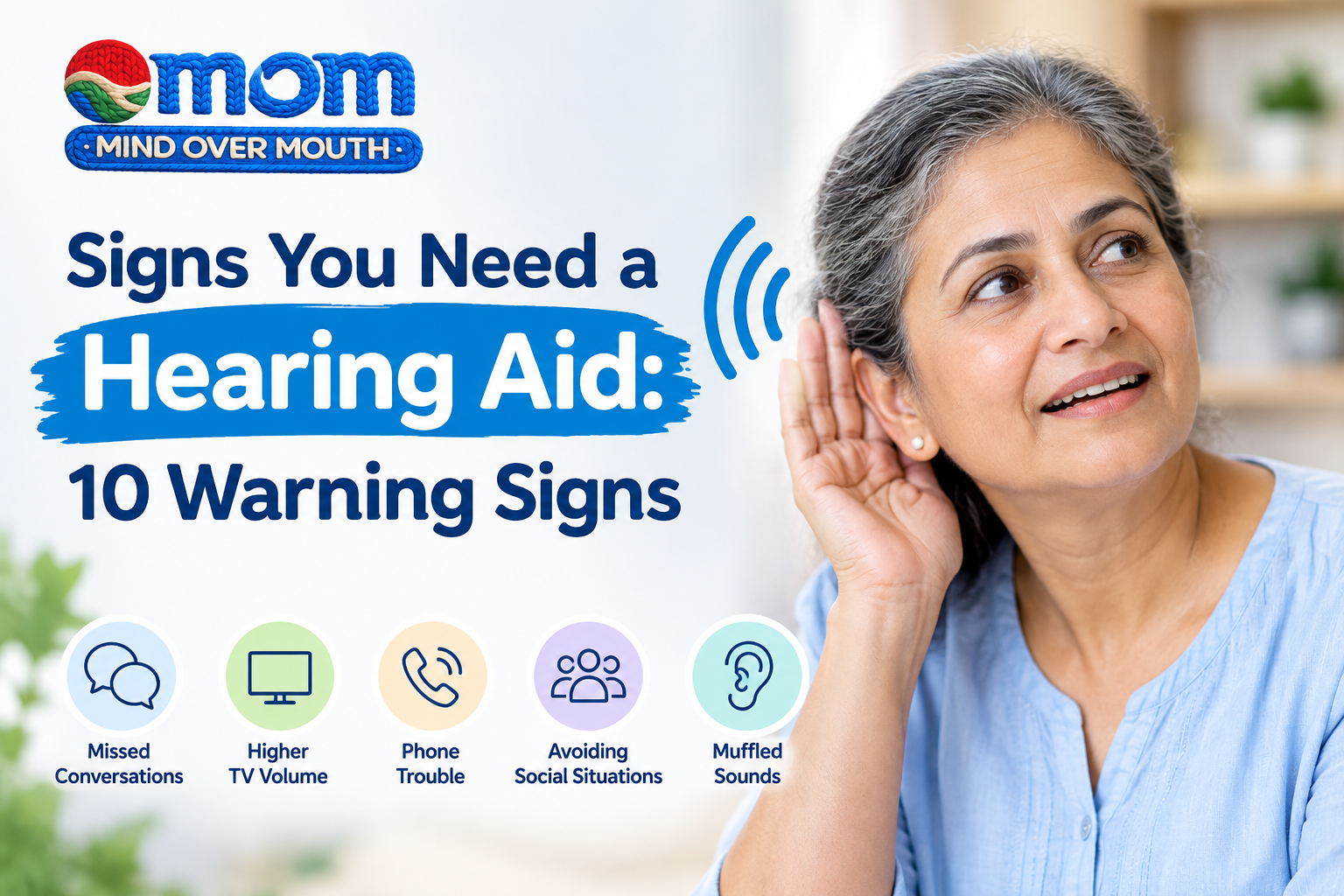
Signs You Need a Hearing Aid: 10 Warning Signs to Know
Hearing changes often happen slowly. You may not notice them at first, but your family or friends might. You may start asking people to repeat themselves, increase the TV volume, or find conversations difficult in crowded places.
These can be signs you need a hearing aid, but symptoms alone cannot tell you whether a hearing aid is right for you. A proper hearing assessment can identify the type and degree of hearing loss and help determine which treatment or hearing technology may be suitable.
Early identification matters. The World Health Organization recommends early identification and appropriate management of hearing loss because timely intervention can help reduce its impact on everyday communication and participation.
If you are asking, “Do I need a hearing aid?”, here are some common signs to pay attention to.
What Are the Signs That You Need a Hearing Aid?
There is no single symptom that means a person definitely needs a hearing aid. However, several everyday problems can suggest that your hearing should be assessed.
Common signs you may need a hearing aid include:
- Frequently asking people to repeat themselves
- Struggling to understand speech in noisy places
- Turning the TV or phone volume higher
- Finding telephone conversations difficult
- Hearing voices but not understanding the words clearly
- Feeling that people are mumbling
- Missing doorbells, alarms or phone calls
- Finding group conversations difficult
- Avoiding social situations because communication is tiring
- Depending on family members to repeat or explain conversations
These are also recognized warning signs of possible mild-to-moderate hearing loss.
Having one of these symptoms does not automatically mean you need a hearing aid. It means your hearing may deserve a closer look.
10 Signs You May Need a Hearing Aid
1. You Frequently Ask People to Repeat Themselves
Do you often say, “Please repeat that”?
Occasionally missing something is normal. But if you regularly ask family members, friends or colleagues to repeat themselves, it may be one of the early signs of hearing loss.
You might hear that someone is speaking but miss important words in the sentence.
A hearing assessment can help determine whether the problem is related to hearing loss or another ear condition.
2. You Struggle to Hear in Noisy Places
Restaurants, weddings, offices and family gatherings can be challenging when several people are talking at once.
You may hear sounds but have difficulty separating one person's voice from background noise.
Difficulty following speech in groups or noisy environments is a common sign associated with hearing difficulty.
If this happens regularly, it is worth considering a hearing test.
3. You Keep Turning Up the TV Volume
One of the simplest things to notice at home is the television volume.
If your family regularly says that the TV is too loud, while you feel that the volume is comfortable, it may indicate that some sounds are becoming harder for you to hear.
Increasing TV or radio volume is one of the practical signs used to identify possible hearing difficulty.
4. You Have Trouble Hearing on the Phone
Telephone conversations can be difficult because you cannot use facial expressions or lip movements to support what you hear.
You may find yourself asking callers to:
- Speak louder
- Speak more slowly
- Repeat themselves
- Move somewhere quieter
If phone conversations have become noticeably harder, a hearing assessment may help explain why.
5. Speech Sounds Muffled or Unclear
Another common hearing problem is hearing someone's voice but struggling to understand the actual words.
People may seem to be mumbling even when they are speaking normally.
This can be particularly noticeable when several people are talking or when there is background noise.
6. You Miss Everyday Sounds
Hearing loss can affect more than conversations.
You might begin missing:
- Doorbells
- Phone notifications
- Alarm sounds
- Someone calling your name
- Traffic sounds
- Household appliances
If everyday sounds that you previously noticed are becoming difficult to hear, consider having your hearing checked.
7. You Find Group Conversations Exhausting
Following a conversation requires more effort when parts of speech are difficult to hear.
You may concentrate intensely on someone's face, guess missing words or constantly ask for repetition.
If conversations regularly leave you mentally tired, it can be useful to discuss the problem with an audiologist or other qualified hearing professional.
8. You Avoid Social Situations
Some people with hearing difficulties begin avoiding restaurants, family gatherings or group discussions because they cannot comfortably follow conversations.
This can gradually affect communication and participation.
Hearing rehabilitation can include hearing aids and other communication support depending on the person's needs. WHO states that appropriate rehabilitation can help people with hearing loss participate in everyday activities, work and social life.
9. Your Family Notices the Problem Before You
Hearing loss can develop gradually, making the change difficult to notice yourself.
Your family may tell you:
“You don't hear us when we call you.”
Or:
“The TV is too loud.”
These observations should not be ignored if they happen repeatedly.
A hearing assessment can provide a clearer picture of what is actually happening.
10. Hearing Difficulty Is Affecting Daily Life
Perhaps the most important question is:
Is your hearing problem interfering with everyday communication?
If hearing difficulty affects conversations at home, communication at work, telephone calls or social activities, it may be time to arrange a hearing assessment.
The goal is not simply to determine whether you need a hearing aid. The goal is to understand your hearing and find the appropriate solution.
How to Know If You Need a Hearing Aid
If you are wondering “How do you know when you need a hearing aid?”, start with a professional hearing evaluation.
A hearing assessment can help determine:
- Whether hearing loss is present
- The degree of hearing loss
- Whether one or both ears are affected
- Which frequencies are affected
- Whether an underlying ear problem needs medical attention
- Whether a hearing aid may provide useful amplification
- What type of hearing technology may suit your needs
An audiologist can assess hearing and, where appropriate, help with hearing aid selection, fitting and adjustment.
Do I Need a Hearing Aid or a Different Treatment?
Not every hearing problem requires a hearing aid.
For example, some hearing difficulties may be related to an ear condition that requires medical treatment. An ear examination may therefore be important before choosing a hearing device.
A hearing professional or doctor can help determine the appropriate next step.
When Should You Get a Hearing Aid?
There is no specific age at which everyone should get a hearing aid.
A hearing aid may be appropriate when:
- Hearing loss has been confirmed
- Communication has become difficult
- Amplification could improve hearing ability
- The device suits your level and type of hearing loss
- Your hearing professional recommends or supports its use
The choice should be based on your hearing needs rather than simply your age.
A hearing aid is a small electronic device that makes certain sounds louder so that people with hearing loss can communicate and participate more easily in everyday activities.
What About Mild Hearing Loss?
Even mild hearing loss can affect conversations, particularly in noisy environments.
Depending on the person and the degree of hearing difficulty, a hearing professional may recommend monitoring, communication strategies, assistive technology or a hearing aid.
The important step is understanding the hearing loss first.
Can Hearing Loss Be Treated With a Hearing Aid?
A hearing aid can help many people manage hearing loss, but it does not cure every type or cause of hearing loss.
Hearing aids work by receiving sound through a microphone, processing and amplifying it, and delivering the modified sound through a speaker. They are designed to make certain sounds easier to hear.
The benefit depends on factors such as:
- Type of hearing loss
- Degree of hearing loss
- Condition of the ear
- Hearing needs
- Device selection
- Hearing aid programming and fitting
- Consistent use and adjustment
For this reason, simply buying a hearing aid is not the whole process.
Why Hearing Aid Fitting Matters
Hearing aid fitting is an important part of hearing care.
The device needs to be appropriate for the person's hearing profile and communication needs. A hearing professional can help select, program and adjust the device.
Professional fitting can also help the user understand:
- How to wear the device
- How to operate it
- How to maintain it
- How to manage different listening environments
- When adjustments may be needed
NIDCD notes that prescription hearing aids can be programmed by hearing professionals according to an individual's hearing loss.
What Happens If Hearing Loss Is Ignored?
Persistent hearing loss should not simply be dismissed.
Unaddressed hearing difficulty can make communication harder and may affect social participation and everyday activities. WHO emphasizes early identification and appropriate management of hearing loss.
You may notice that you:
- Miss important parts of conversations
- Avoid group discussions
- Depend on others to explain things
- Find communication tiring
- Participate less in social activities
However, the effects are different for every person.
The best approach is to identify the hearing problem early and discuss appropriate options with a qualified professional.
Hearing Problems in Adults: Common Causes
Hearing problems in adults can have different causes.
Some possible causes include:
- Age-related hearing changes
- Long-term exposure to loud sounds
- Certain ear conditions
- Ear infections
- Earwax blockage
- Injury
- Some medicines that can affect hearing
- Other medical conditions
WHO identifies loud sound exposure and some medicines as preventable contributors to hearing loss, while also emphasizing the importance of identifying and managing ear conditions.
This is why it is not always appropriate to assume that hearing loss is simply due to age.
What Are the Early Signs of Hearing Loss?
The early signs of hearing loss may be subtle.
You may notice:
- People seem to mumble.
- You frequently ask for repetition.
- Conversations are harder in restaurants.
- You increase the TV volume.
- Phone calls are more difficult.
- You struggle to follow group discussions.
- You miss some everyday sounds.
- Listening requires more concentration.
If these problems occur regularly, consider arranging a hearing test.
NIDCD provides a hearing-related questionnaire for adults that includes difficulty hearing family members, co-workers, television and conversations in restaurants among the situations that can indicate a need for hearing evaluation.
How to Tell If You Have Hearing Loss
A simple way to start is to consider how your hearing affects everyday situations.
Ask yourself:
| Question | What it may indicate |
|---|---|
| Do people often repeat themselves? | Difficulty understanding speech |
| Is the TV louder than other people prefer? | Reduced ability to hear certain sounds |
| Do you struggle in restaurants? | Difficulty separating speech from background noise |
| Are phone calls difficult? | Trouble understanding speech without visual cues |
| Do people sound like they mumble? | Reduced speech clarity |
| Do you miss alarms or doorbells? | Difficulty hearing everyday sounds |
| Do conversations make you tired? | Increased listening effort |
This is not a diagnosis. A professional hearing assessment is needed to determine whether hearing loss is present and what type of support may be appropriate.
When Should You Have a Hearing Test?
Consider arranging a hearing test in Hisar or elsewhere if you have persistent difficulty hearing conversations or everyday sounds.
A hearing assessment is especially important if your hearing:
- Has changed noticeably
- Is affecting communication
- Is affecting work or social activities
- Is different between the two ears
- Is accompanied by other ear symptoms
WHO recommends hearing assessment and early identification for people with suspected hearing loss.
Sudden Hearing Loss Needs Prompt Medical Attention
Do not simply purchase a hearing aid if hearing loss occurs suddenly or worsens rapidly.
Other warning signs that need medical evaluation include:
- Sudden hearing loss
- Rapidly worsening hearing
- Hearing loss mainly in one ear
- Significant difference between the ears
- Ear pain
- Fluid or blood from the ear
- Vertigo with hearing loss
- Hearing loss with certain other concerning ear symptoms
NIDCD and FDA guidance identify these situations as reasons to seek evaluation rather than relying on a hearing aid alone.
Hearing Test in Hisar
If you live in Hisar and are experiencing persistent hearing difficulty, a hearing test in Hisar can be a useful first step.
A professional evaluation can help you understand whether you have hearing loss and whether you may benefit from hearing technology such as a hearing aid.
Mind Over Mouth provides hearing-related services alongside its communication and therapy-focused services. Before making an appointment, check the current service availability and appointment information directly with the centre.
For someone considering a hearing aid in Hisar, the important point is not to select a device based only on price, appearance or another person's experience. Hearing needs vary from person to person.
A hearing assessment can help guide the decision.
Frequently Asked Questions
What are the signs that you need a hearing aid?
Frequent repetition requests, difficulty hearing in noisy places, high TV volume, trouble with phone conversations and difficulty understanding speech can be signs that your hearing should be assessed. These symptoms do not by themselves confirm that you need a hearing aid.
How do you know when you need a hearing aid?
A hearing assessment can determine the type and degree of hearing loss and help establish whether a hearing aid could be useful for your communication needs.
What are the early signs of hearing loss?
Early signs can include difficulty following conversations, especially in noisy places, asking people to repeat themselves, increasing TV volume and finding speech less clear.
Can hearing loss be treated with a hearing aid?
Hearing aids can help many people hear amplified sounds more clearly, but they do not treat every underlying cause of hearing loss. The appropriate solution depends on the individual's hearing condition.
When should someone get a hearing aid?
A hearing aid may be considered when hearing loss has been identified and amplification is appropriate for the person's hearing needs and daily communication requirements.
How to tell if you have hearing loss?
Regularly struggling with conversations, phone calls, group discussions or everyday sounds can suggest hearing difficulty. A hearing assessment is needed to confirm hearing loss.
What happens if hearing loss is ignored?
Persistent hearing loss can interfere with communication and participation in daily and social activities. Early identification allows appropriate management and rehabilitation options to be considered.
Should I buy a hearing aid before getting a hearing test?
It is generally useful to have your hearing evaluated before choosing a device because hearing loss can have different causes and levels. FDA guidance also recommends considering hearing evaluation to determine the type and amount of hearing loss and appropriate device selection.
Final Takeaway
The signs you need a hearing aid are often noticed during everyday situations rather than through one obvious symptom.
If you regularly ask people to repeat themselves, struggle to follow conversations in noisy places, turn the TV volume up or find speech less clear, consider getting your hearing assessed.
A hearing test can help identify what is happening and whether you may benefit from a hearing aid for hearing loss, another hearing technology or medical treatment.
For people looking for a hearing test in Hisar or information about a hearing aid in Hisar, a professional assessment is a practical starting point.
Do not ignore sudden or rapidly worsening hearing loss, significant one-sided hearing changes or hearing problems accompanied by pain, drainage or severe dizziness. These symptoms require medical evaluation.
Medical disclaimer: This article is for general educational information and does not replace an examination, diagnosis or treatment plan from a qualified healthcare professional.