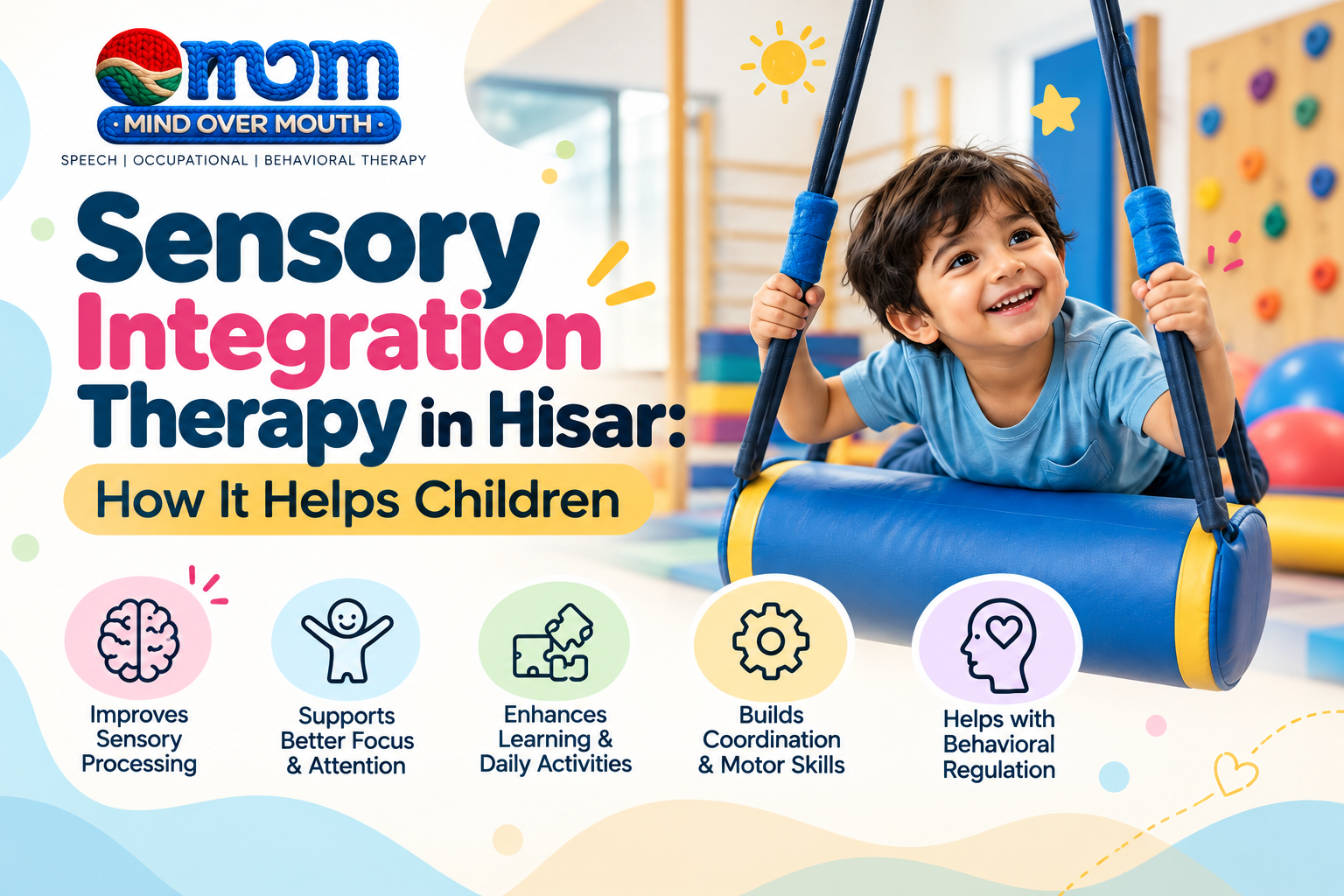
Sensory Integration Therapy in Hisar: How It Helps Children
Children experience the world through their senses every day. Sounds, lights, touch, movement, body position, smells and other sensory information help them understand what is happening around them. For some children, processing this information can be difficult. They may become uncomfortable with certain sounds, avoid particular textures, seek constant movement, have difficulty sitting for activities or become overwhelmed in busy environments.
Sensory Integration Therapy in Hisar is an occupational therapy approach that may be used to address functional difficulties related to sensory processing. It uses carefully selected activities and sensory experiences based on the child's individual needs and goals.
At Mind Over Mouth , sensory-related concerns can be considered as part of a broader assessment of a child's daily participation, communication, learning, play and self-care needs. Sensory therapy should not be treated as a one-size-fits-all program. The right approach depends on the individual child.
What Is Sensory Integration Therapy?
Occupational therapy frequently includes a technique called sensory integration treatment, which focuses on how a person receives, interprets, and reacts to sensory input.
Occupational therapist A. Jean Ayres created the idea of sensory integration by explaining how the nervous system interprets sensory data and enables an individual to react to their surroundings properly.
A child receives sensory information from several systems, including:
- Touch: information from the skin and contact with objects
- Auditory system: sounds and voices
- Visual system: sights, movement and surroundings
- Vestibular system: balance and movement
- Proprioceptive system: information about body position and movement
- Taste and smell: information related to food and the environment
The brain has to organize this information so the child can respond to everyday situations.
For example, sitting in a classroom requires a child to process sounds, visual information, body position and movement while also paying attention to the teacher. When sensory processing difficulties interfere with daily activities, an occupational therapist may consider sensory-based strategies as part of an individualized therapy plan.
What Is Sensory Processing?
Sensory processing refers to the way the nervous system receives and interprets information from the senses and helps a person respond.
A child may respond differently to the same sensory experience as another child.
For example:
- One child may enjoy loud music.
- Another child may cover their ears.
- One child may enjoy messy play.
- Another may avoid touching sand or paint.
- One child may constantly move around.
- Another may become uncomfortable with movement.
- Some children may seek strong physical activities.
- Others may become overwhelmed by busy environments.
These differences do not automatically mean that a child has a medical disorder. Sensory difficulties can occur alongside different developmental or behavioral conditions, and a proper assessment is important. The American Academy of Pediatrics has specifically cautioned against treating "sensory processing disorder" as a universally established standalone diagnosis.
What Are Common Signs of Sensory Processing Difficulties?
Sensory-related difficulties can look different from one child to another.
Parents may notice behaviors such as:
Sensitivity to Sounds
A child may:
- Cover their ears frequently
- Become upset around loud sounds
- Avoid crowded or noisy places
- Have difficulty concentrating when there is background noise
Sensitivity to Touch
Some children may dislike:
- Certain clothing materials
- Hair brushing
- Nail cutting
- Being touched unexpectedly
- Playing with materials such as sand, clay or paint
Sensitivity to Movement
A child may appear uncomfortable with:
- Swings
- Slides
- Fast movement
- Changes in body position
Other children may actively seek movement and enjoy jumping, spinning or running.
Difficulty with Body Awareness
A child may appear to have difficulty judging how much force to use when:
- Holding objects
- Pushing or pulling
- Writing
- Playing
- Moving around other people
Difficulty Staying Regulated
Some children may have difficulty remaining calm or organized during:
- Transitions
- Classroom activities
- Social situations
- Shopping trips
- Family gatherings
- Other busy environments
These signs alone do not establish a diagnosis. A professional assessment should consider the child's overall development and how these behaviors affect everyday life.
How Does Sensory Integration Therapy Help Children?
The main purpose of therapy is not simply to expose a child to different sensory experiences. The focus should be on helping the child participate more effectively in meaningful daily activities.
Depending on the child's needs, therapy may work toward goals related to:
- Attention during activities
- Participation in play
- Tolerance of certain sensory experiences
- Body awareness
- Motor planning
- Coordination
- Self-care activities
- Classroom participation
- Transitions between activities
- Functional independence
For example, if a child becomes overwhelmed by certain classroom sounds, therapy may focus on strategies that support participation rather than simply trying to make the child tolerate every sound.
Similarly, if a child avoids particular textures, the therapist may gradually introduce appropriate activities while considering the child's comfort and functional goals.
How Is a Child's Sensory Need Evaluated?
A therapist may begin by understanding the child's everyday difficulties.
The assessment can include information about:
- Developmental history
- Daily routines
- Communication
- Play
- School participation
- Motor skills
- Self-care
- Sensory responses
- Parent concerns
- Teacher observations
The most useful assessment is one that connects observations to the child's actual daily activities.
What Are the Possible Benefits of Sensory-Based Occupational Therapy?
Potential goals can vary from child to child.
Depending on the individual situation, therapy may aim to support:
- Better participation in everyday activities
- Improved tolerance of certain sensory experiences
- Better body awareness
- Improved coordination
- More effective participation in play
- Greater independence in self-care
- Better participation in classroom routines
- Support during transitions
- Improved ability to engage in specific activities
It is important to avoid promising the same outcome for every child.
Research on sensory integration approaches has produced mixed findings. A systematic review published in Pediatrics found some limited short-term improvements in specific sensory and motor outcomes, while also noting that the evidence base was small and that the durability of effects was unclear.
What Parents Can Do at Home
Parents can play an important role in supporting a child's therapy goals.
Simple steps may include:
Observe Patterns
Note when sensory-related difficulties happen.
For example:
- Is it during meals?
- In crowded places?
- During schoolwork?
- Before bedtime?
- During dressing?
Keep Routines Predictable
Many children benefit from knowing what activity comes next.
Communicate With the Therapist
Share changes you notice at home or school.
Focus on Functional Goals
Instead of asking only whether the child "likes" an activity, consider whether therapy is helping with something meaningful, such as dressing, playing, sitting for an activity or participating in school.
Avoid Copying Therapy Activities Without Guidance
A sensory activity that helps one child may not be appropriate for another. Parents should discuss home strategies with the child's therapist.
When Should Parents Consult an Occupational Therapist?
Consider discussing an assessment with an occupational therapist if sensory-related difficulties are regularly interfering with a child's everyday activities.
For example, professional guidance may be useful when a child:
- Frequently becomes overwhelmed by ordinary environments
- Avoids many everyday textures or activities
- Has significant difficulty with movement or coordination
- Struggles with dressing or personal-care routines
- Has difficulty participating in school activities
- Finds transitions extremely difficult
- Has sensory behaviors that interfere with family life
- Shows developmental concerns alongside sensory difficulties
A sensory concern should be viewed in the context of the child's overall development.
Sensory Integration Therapy in Hisar at Mind Over Mouth
Mind Over Mouth provides therapy services in Hisar with a focus on communication, occupational therapy and related developmental needs.
For families considering Sensory Integration Therapy in Hisar, the first step should be understanding the child's specific difficulties rather than selecting therapy based only on a symptom or online checklist.
A suitable therapy plan may consider:
- The child's age
- Developmental needs
- Sensory responses
- Communication
- Motor skills
- Daily routines
- School participation
- Family priorities
- Functional goals
For children requiring Sensory Processing Therapy in Hisar, occupational therapy can be considered as part of an individualized plan when sensory difficulties are affecting everyday participation.
The goal is practical: help the child take part in daily activities as comfortably and independently as possible.
How to Choose Sensory Therapy for Children in Hisar
Parents can ask a therapy provider several useful questions before starting:
- Who will assess my child?
- What areas will the assessment cover?
- What are the main therapy goals?
- How will progress be measured?
- How will parents be involved?
- What activities can be continued safely at home?
- How often will the child's progress be reviewed?
- What other professionals should be involved if additional developmental concerns are present?
These questions can help parents understand whether the therapy plan is connected to the child's actual needs.
Frequently Asked Questions
What is Sensory Integration Therapy and how does it help children?
Sensory Integration Therapy is an occupational therapy approach that uses individualized sensory and movement activities to support a child's ability to participate in everyday activities. Goals can include areas such as motor planning, self-care, play and classroom participation.
Is Sensory Integration Therapy suitable for every child?
No. Sensory-related therapy should be based on an individual assessment and functional goals. Children can have very different sensory needs, and not every sensory activity is suitable for every child.
What is Sensory Processing Therapy in Hisar?
Sensory Processing Therapy in Hisar is a term commonly used for therapy approaches that address difficulties with how a child responds to sensory information. Occupational therapy may include sensory strategies as part of a broader individualized plan.
What is Occupational Therapy for Sensory Issues in Hisar?
Occupational Therapy for Sensory Issues in Hisar focuses on difficulties that affect everyday activities. Depending on the child's needs, therapy may address sensory responses, coordination, self-care, play, writing, attention and participation.
What age group can receive pediatric sensory therapy?
Children of different ages may be assessed for sensory-related difficulties. The therapy goals and activities should be adjusted according to the child's age, development and functional needs.
Can sensory therapy cure autism or ADHD?
Sensory therapy should not be presented as a cure for autism or ADHD. Sensory-based approaches may be used as one part of a broader support plan when appropriate.
How long does sensory integration therapy take?
There is no single session length or treatment duration that applies to every child. The frequency and duration should depend on the child's goals, response to therapy and professional assessment.
How do I find Sensory Integration Therapy in Hisar?
Parents can look for a qualified occupational therapy provider in Hisar and ask about assessment, therapist qualifications, individualized goals and progress monitoring before starting therapy.